
Understanding the SCA Cupping Score: What It Means for Coffee Quality | Bean Belt Bridge
What does the SCA Cupping Score mean for coffee quality? Find out at Bean Belt Bridge how coffee beans are professionally evaluated and classified. Understanding the SCA Cupping Score
COFFEE
If you spend any time in the world of coffee, you will inevitably run into the term SCA Cupping Score. But what exactly does SCA mean, and what lies behind those magical numbers proudly displayed on the packaging of high-end coffees?
The Cupping Score from the Specialty Coffee Association (SCA) is the global currency for coffee quality. It determines whether a coffee gets to shine as a "specialty coffee" or ends up as ordinary, mass-market commodity grade.
Here, you will learn everything you need to know about the SCA point system, the strict quality criteria, and the notorious defect classes.
What is the SCA Cupping Score?
The SCA Cupping Score is a standardized, worldwide grading system (0 to 100 points) used for the sensory evaluation of coffee quality. It serves coffee professionals around the globe as an essential tool to make the quality of green coffee beans objectively measurable.
This evaluation is based on various sensory attributes such as aroma, flavor, acidity, body, and aftertaste. Each of these characteristics is graded on a scale, enabling experts to precisely determine the overall quality of a coffee sample.
The Point System Explained
To determine the SCA Cupping Score, experienced tasters (known as Q Graders) follow a strict, systematic protocol that involves several steps:
Controlled Brewing: The coffee samples are prepared in a strictly controlled environment. For the cupping (tasting) process, the green coffee is always sample-roasted fresh and very light (within 24 hours prior to testing). This is the only way to accurately detect the subtle nuances of flavor.
Sensory Analysis: Tasters evaluate the fragrance and aroma of the coffee, test it directly for flavor as well as body, and note the finish or aftertaste.
Score Assignment: A total of 10 attributes are evaluated, with each receiving up to 10 points (including aroma, flavor, aftertaste, acidity, body, balance, sweetness, and clean cup).
The maximum achievable score is 100. This system allows for an extremely nuanced evaluation that captures even the finest subtleties and unique characteristics of each individual coffee sample. Deductions are made if faults or defects are found in the coffee.
The SCA Classification
The final score categorizes the coffee into clear quality tiers. For the coffee world, the 80-point mark acts as the magic threshold: anything below it is considered standard commercial coffee (commodity), while anything scoring 80 points or higher can officially call itself Specialty Coffee.


The Foundation: Green Coffee Defect Classes (SCA Defect Rate)
Before the coffee is even tasted, inspectors examine a 350-gram sample of green coffee for visual and physical flaws. The SCA divides these defects into two categories.
⚠️ The Golden Rule for Specialty Coffee: > A sample must contain 0 Category 1 defects (primary defects) and a maximum of 5 Category 2 defects (secondary defects). A single primary defect leads to immediate disqualification from specialty status.
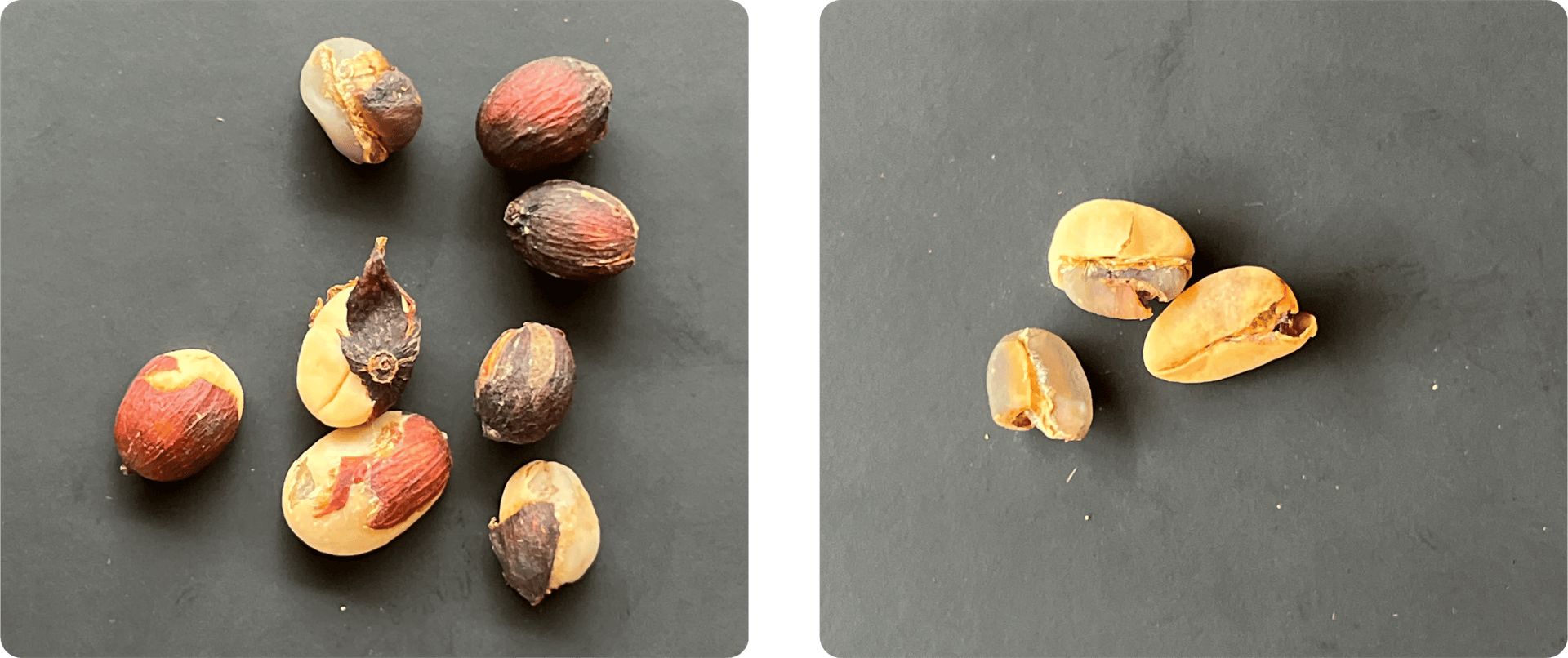
Category 1: Primary Defects (Severe Flaws)
In this category, a single defective bean is enough to completely ruin the taste of the entire cup (taint).
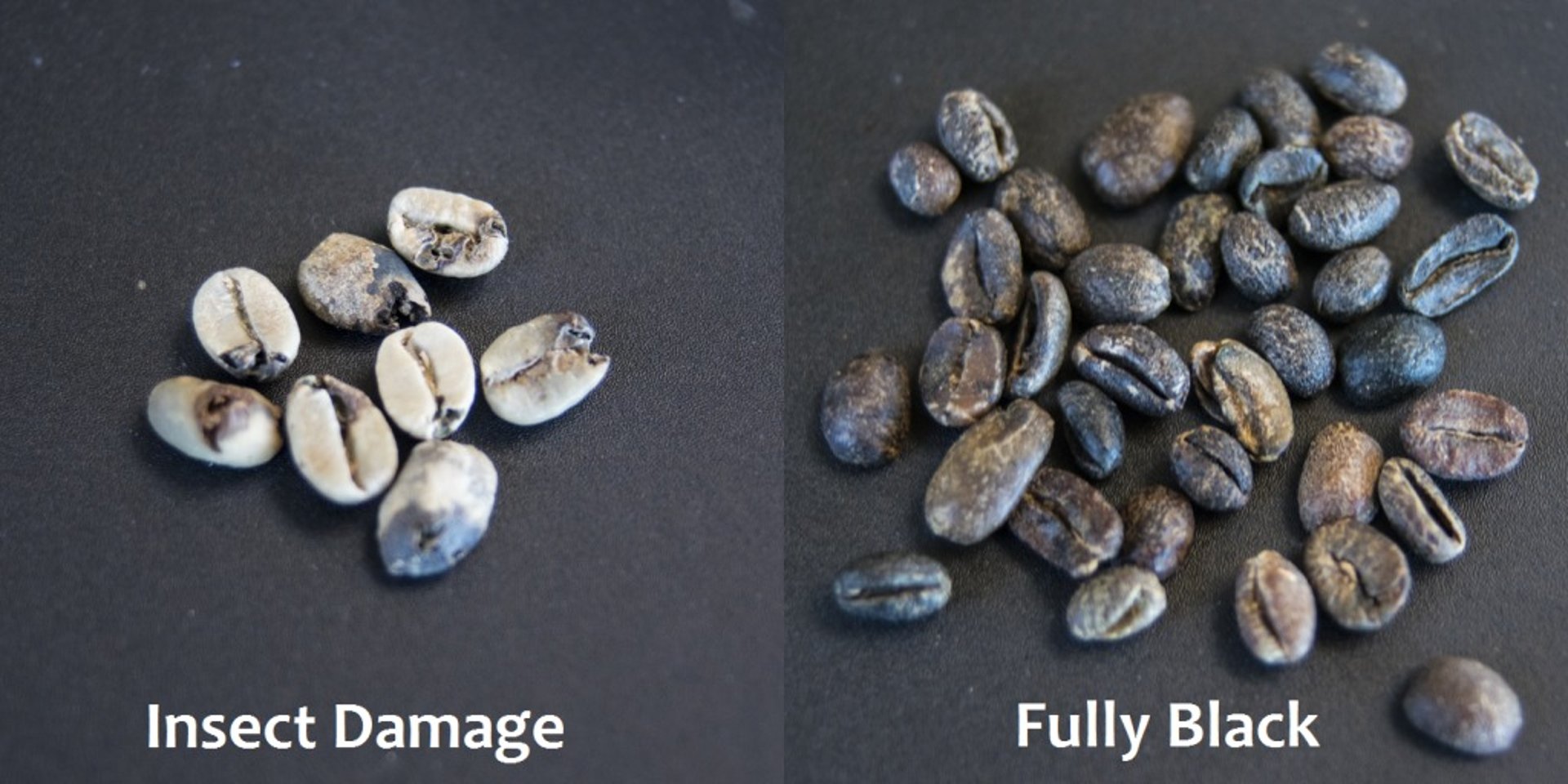
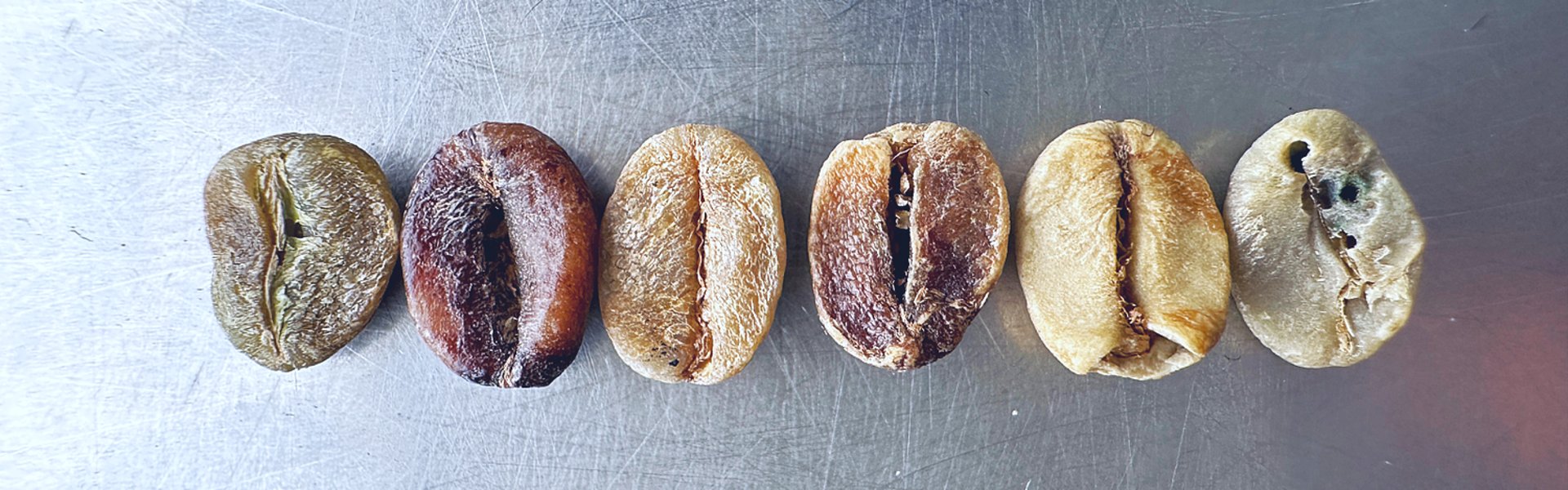
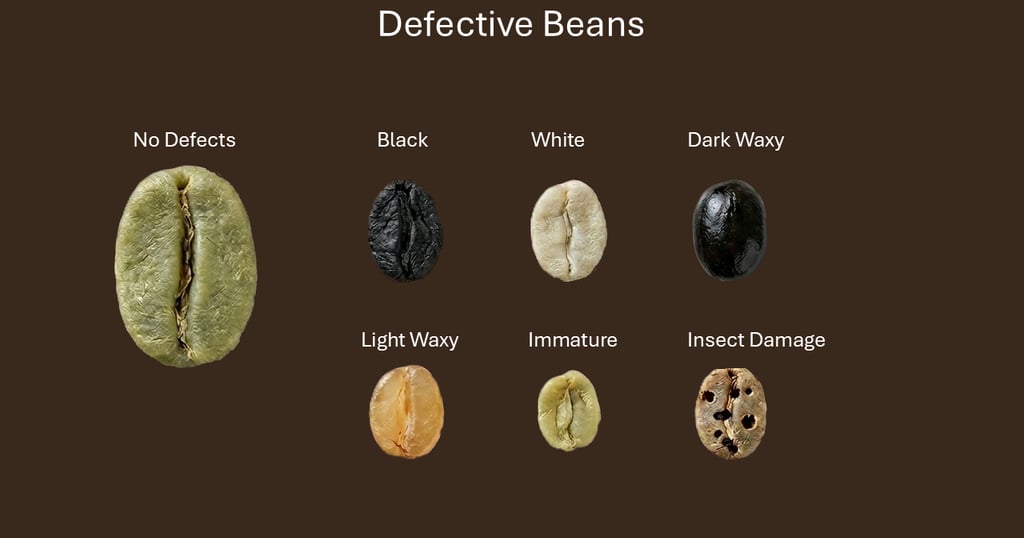
Full Black (Dark Waxy): Caused by fermented dead cherries or extreme water deprivation. Flavor profile: ashy, sour, phenolic.
Full Sour: Caused by uncontrolled fermentation with yeast or bacteria. Flavor profile: vinegary-sour or rotten.
Dried Cherry / Pod: A whole, unhulled coffee cherry ended up in the sample. Flavor profile: fruity-rotten.
Fungus Damaged: Occurs due to excessive moisture during storage or drying. Flavor profile: moldy, earthy, musty.
Severe Insect Damage: The bean has 5 or more boreholes (usually caused by the coffee berry borer).
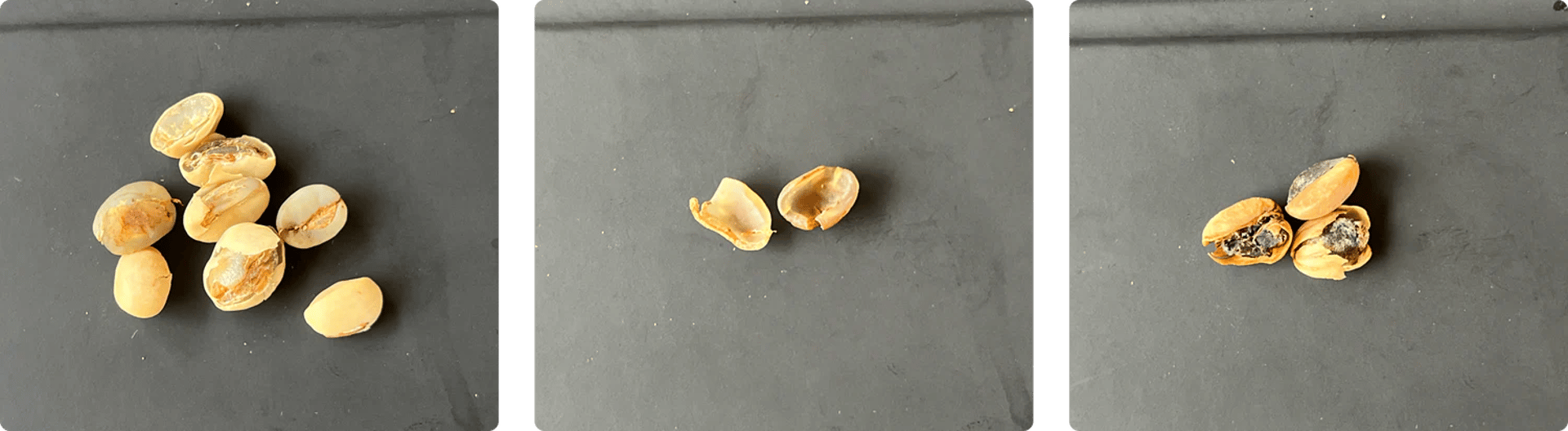
Category 2: Secondary Defects (Minor Flaws)
These defects only noticeably impact quality when present in larger quantities. Multiple beans are required to count as one official "defect point":
Partial Black / Partial Sour: Only parts of the bean are black or sour.
Parchment: The bean is still surrounded by its woody protective layer.
Floater: A lightweight, immature, or poorly nourished bean that floats to the top in water.
Immature / Unripe (Light Waxy) : Recognizable by the tightly adhering silverskin. Flavor profile: grassy, astringent (mouth-drying).
Withered: Small and wrinkled due to a lack of water for the plant .
Broken / Chipped: Mechanically damaged bean from the hulling machine.
Slight Insect Damage: Fewer than 5 boreholes in the bean.
A Critical Factor: Moisture Content
An often-overlooked but critical quality factor for international trade is the water content of the green coffee bean.
The Ideal Range: Between 9.0% and 12.0% (The official SCA standard for specialty coffee requires 10.0% to 12.0%).
Too High (Over 12.5%): There is an acute risk of mold growth during transport in shipping containers. The coffee will spoil.
Too Low (Under 9.0%): The bean rapidly loses its flavor complexity, ages extremely fast, tastes woody, and becomes nearly impossible to control evenly during roasting.
The New SCA System: Scoring in Detail
You might have already seen evaluation sheets where the scale appears unusually structured (e.g., in the modern SCA Coffee Value Assessment). Here is the explanation of how the points are put together:
The Sensory Attributes (Fragrance, Aroma, Flavor, etc.): These are evaluated on a scale from 1 (extremely low) to 9 (extremely high). This is a so-called "hedonic scale" that measures the impression of quality. In the background, these values are mathematically weighted so that top scores still result in the classic total of up to 100 points.
The Cup Count (Non-Uniform / Defective Cups): During a cupping session, 5 cups are always brewed in parallel per coffee. The fields from 0 to 5 on the sheet indicate how many of these cups taste inconsistent or show genuine defects. The goal is a clean 0—the more faulty cups found, the more drastic the point deduction for the entire lot.
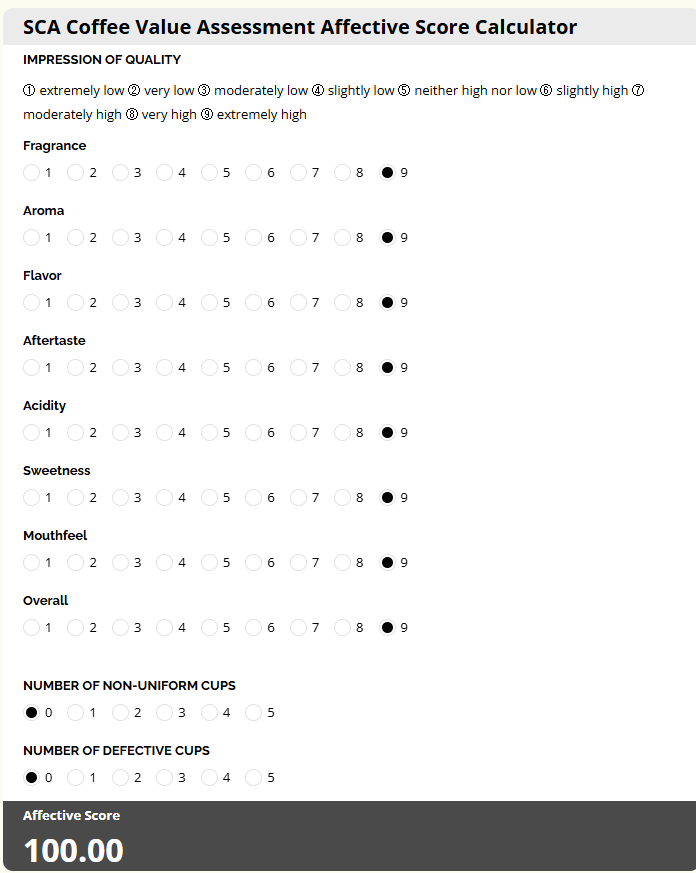
SCA Coffee Value Assessment Affective Score Calculator
Source: Specialty Coffee Association
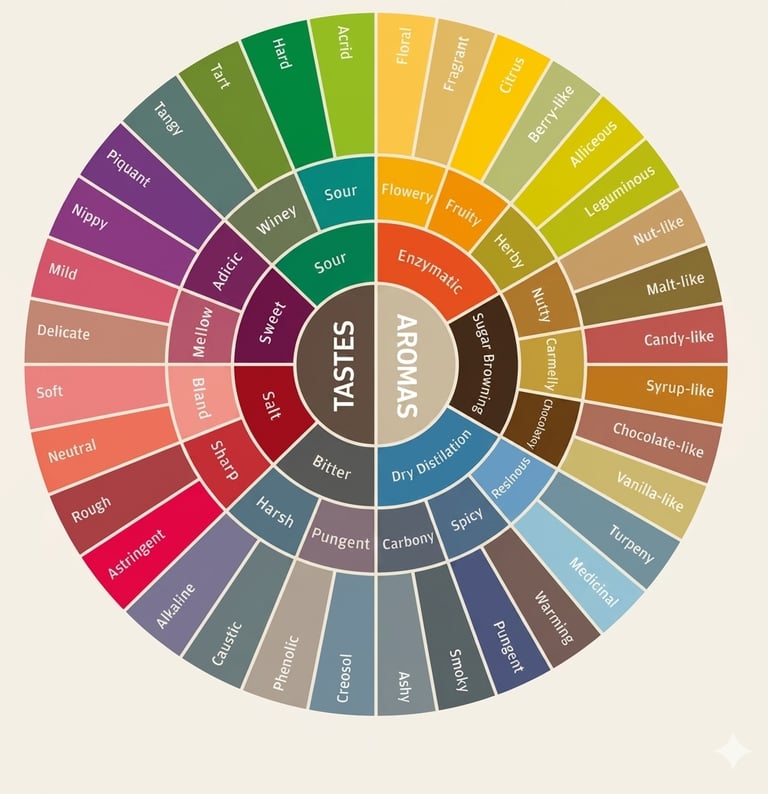
The Tool for Taste: The Coffee Taster's Flavor Wheel
While the SCA Cupping Score provides the mathematical grade (e.g., 85 points), the SCA Coffee Taster's Flavor Wheel provides the words to match. It is the most important tool for Q Graders to precisely decode and name the flavor of a coffee.
When a taster evaluates the attributes "Fragrance/Aroma" or "Flavor" on the cupping form, they use the flavor wheel as the shared language of the coffee industry.
How is the Flavor Wheel used during cupping?
The wheel is structured from the inside out. When a taster tastes a coffee, they work their way forward in three steps:
The General Direction (Center): Does the coffee taste rather fruity, nutty, floral, or sweet?
The Refinement (Middle Ring): If the coffee is "fruity"—is it more towards citrus fruits, berries, or dried fruits?
The Exact Note (Outer Ring): If it is a citrus fruit—does the flavor specifically remind them of grapefruit, lemon, lime, or orange?
Why is this interplay so important?
A high SCA Cupping Score (e.g., 88 points) tells a roaster or consumer that the coffee is of outstanding quality—but it doesn't tell them how it tastes. The full profile only emerges through the combination of the score and the flavor descriptions from the Flavor Wheel.
Example: Two different coffees can both have a score of 86 points. According to the flavor wheel, Coffee A tastes like jasmine, bergamot, and blueberry (typical for a washed Ethiopian lot). Coffee B tastes like dark chocolate, brown sugar, and almond (typical for a Brazilian lot).
The flavor wheel therefore ensures that a purely mathematical evaluation turns into a vibrant, relatable taste experience!
Why is the SCA Cupping Score so important?
The SCA Cupping Score plays a fundamental role across the entire specialty coffee market and brings clear advantages to everyone involved in the value chain:
For Roasters: It serves as a reliable benchmark when buying green coffee. A higher cupping score directly signals superior quality, which in turn determines the price and demand on the market.
For Consumers: Understanding the cupping score enriches the coffee experience. Coffee lovers can make informed purchasing decisions that are tailored precisely to their personal taste preferences.
For Producers (Coffee Farmers): Farmers can use the score to specifically fine-tune their cultivation and processing methods. This helps them increase quality and produce coffees that meet the high demands of the global market.
By creating a shared language for coffee quality, the SCA Cupping Score not only ensures greater transparency and fairness in the industry, but also fosters a true culture of appreciation for exceptional coffee worldwide.
Frequently asked questions
Welche weiteren Aufgaben hat die SCA?
Die Specialty Coffee Association (SCA) ist ein weltweiter Non-Profit-Verband. Neben der Definition von Qualitätsstandards (z. B. für Wasserwerte und Röstgrade) betreibt sie das weltbekannte Ausbildungsprogramm (Coffee Skills Program). Zudem fördert sie die wissenschaftliche Kaffeeforschung und richtet die jährlichen Kaffeeweltmeisterschaften (z. B. die World Barista Championship) aus.
Wer genau führt diese Tests durch und kostet das etwas?
Offizielle Bewertungen werden von zertifizierten Q-Gradern durchgeführt. Das sind unabhängige Kaffeesommeliers, die alle drei Jahre extrem schwere Prüfungen ablegen müssen, um ihre Lizenz zu behalten. Um Subjektivität auszuschließen, testen bei offiziellen Ratings meist drei Q-Grader den Kaffee unabhängig voneinander in einer Blindverkostung. Dieser Service ist kostenpflichtig; Kaffeebauern oder Exporteure zahlen eine Gebühr (meist einige hundert Dollar) an ein zertifiziertes Labor für den Aufwand.
Wird nach jeder Kaffeeernte neu getestet?
Ja. Kaffee ist ein Naturprodukt. Ein Farmer kann in einem Jahr einen herausragenden Kaffee (z. B. 88 Punkte) produzieren, im nächsten Jahr aber durch ungünstiges Wetter bei der Trocknung auf 79 Punkte abstürzen. Jede Ernte und jede einzelne Charge (Lot) wird vor dem Verkauf frisch bewertet.
Werden die Ergebnisse veröffentlicht?
Nein, es gibt kein öffentliches Zentralregister für alle Cupping Scores. Die Testergebnisse gehören dem Auftraggeber (z. B. dem Farmer oder Händler)
Wird der Score auf den Verpackungen der Hersteller angegeben?
Ja, aber völlig freiwillig. Da ein hoher SCA Score ein enormes Qualitätsmerkmal ist, drucken Röster Werte ab 80 Punkten (und besonders ab 85 Punkten) sehr gerne gut sichtbar auf ihre Kaffeetüten. Bei gewöhnlichem Supermarktkaffee wird der Score aus Marketinggründen verschwiegen.
Müssen die Ergebnisse zwingend an die SCA übergeben werden?
Nein. Im Alltag nutzen Röster und Einkäufer das Cupping-System für ihre eigenen Qualitätskontrollen und Preisverhandlungen. Nur wenn ein Farmer ein offizielles, international anerkanntes Qualitätszertifikat (Q-Certificate) für seinen Kaffee beantragen möchte, wird der Test offiziell über das CQI (Coffee Quality Institute) eingereicht.
Werden Kaffees unter 50 Punkten trotzdem verkauft?
Ja, absolut. Jede Bohne findet einen Käufer. Kaffees zwischen 50 und 80 Punkten landen im Supermarkt, in Kaffeepads, Instantkaffee oder günstigen Gastro-Mischungen (oft dunkel geröstet, um Mängel zu kaschieren). Kaffees unter 50 Punkten weisen schwere Defekte auf. Selbst sie werden teilweise noch für billigsten löslichen Kaffee genutzt oder in der Industrie zu Koffeinextrakt, Kosmetik oder Biomasse verarbeitet.
Wie wird er geprüft?
Der Feuchtigkeitsgehalt wird mit speziellen digitalen Messgeräten (Moisture Metern) ermittelt. Eine definierte Menge Rohkaffee wird in das Gerät gefüllt, welches über die elektrische Leitfähigkeit oder Hochfrequenz-Kapazitäten den exakten Prozentsatz misst.


